Don't be afraid of the numbers
There's no maths involved
In case it's not obvious, there's no maths here. The numbers are just a convenient reference.
Some people worry that they won't be able to understand Johnny.Decimal because they're 'not a numbers person'. If that sounds like you, let's talk about what they do and why they're useful.
Numbers beat letters
The alphabet is a terrible way to organise things. It's ambiguous and things move around as items are created. So you never achieve the 'muscle memory' of knowing where a thing is, spatially.
As well as logically categorising things, Johnny.Decimal forces things to stick in place using numbers. So stuff doesn't move and you can find it.
For example, you might have seen a folder at work called something like: 01 Jim's Important Stuff
Jim was sick of his folder being lost in a list of a hundred others. So he forced it to the top using a number. He craves structure, but he didn't go far enough. Poor Jim.
A simple hierarchy
Johnny.Decimal groups everything by area, then category, and finally ID.
A maximum of 10 areas are possible in a system
00-09, 10-19, 20-29, 30-39, 40-49,
50-59, 60-69, 70-79, 80-89, 90-99
A maximum of 10 categories are possible in each area
For example, 10-19 contains the categories:
10, 11, 12, 13, 14, 15, 16, 17, 18, 19
A maximum of 100 IDs is possible in each category
.00 to .99
We don't store anything in areas or categories. Only in IDs. This means that everything in a Johnny.Decimal structure is only two levels deep. No more endless clicking down into nested-folder hell.
Example
In the Life Admin System if you want to store a bank statement, click:
- Area
10-19 Life admin - Category
13 Money earned, spent, saved, & owed
That's it. Now you can see the ID 13.41 Bank accounts.
The numbers talk to us
At a glance, we can see exactly where a Johnny.Decimal ID lives in the system. Because each number means something, sort of like a map coordinate.
The number before the decimal tells us what area and category we're in (our structure). The number after the decimal is the ID (our content).
In the diagram below, the number before the decimal is 13. It tells us this ID is in category 13, which is in area 10-19. Notice they both start with a 1? That's another clue that we're in 10-19.
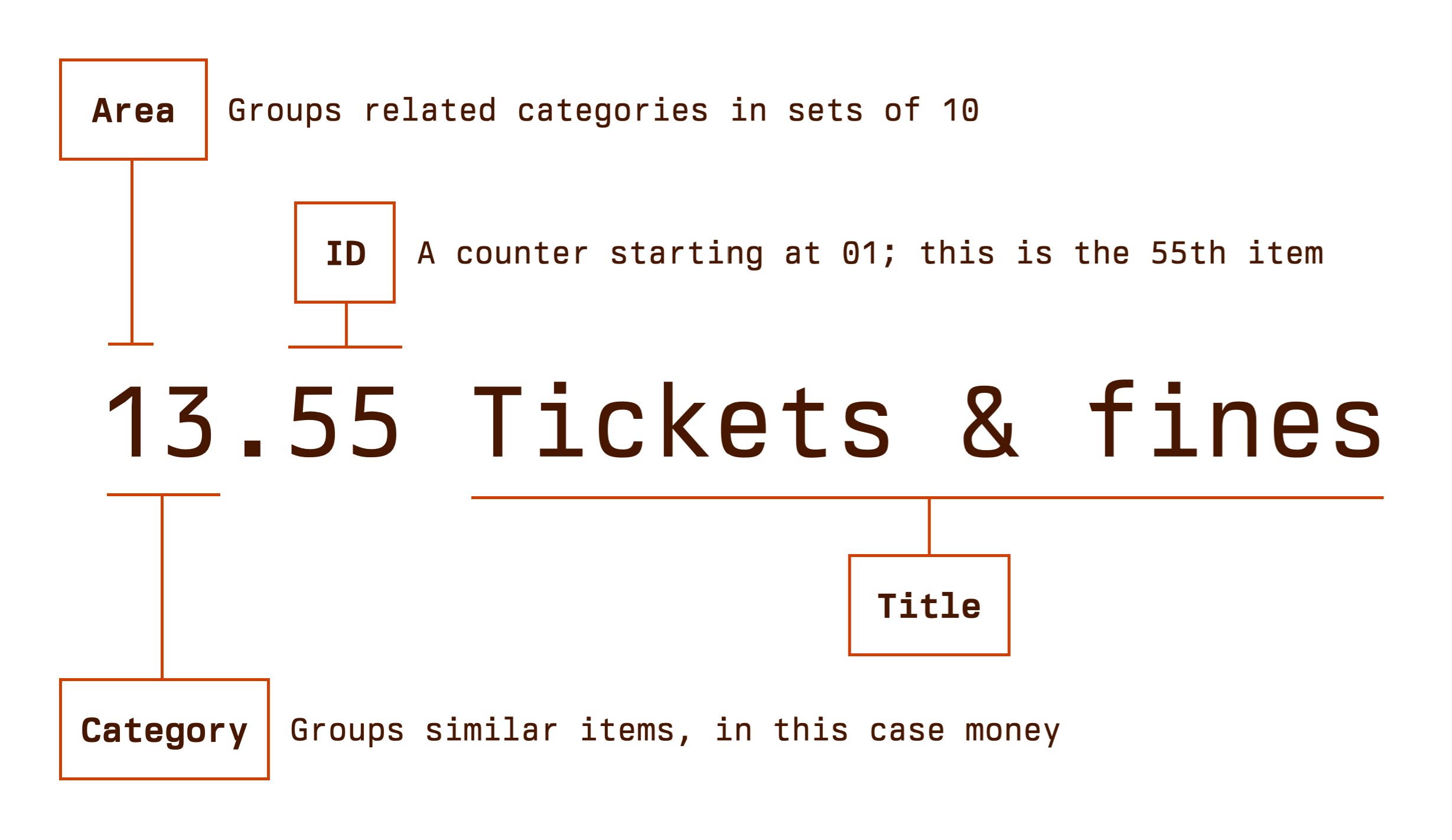
The number after the decimal is 55. It's the 55th item in this category, and where our content related to tickets and fines is stored.
13 Money earned, spent, saved, & owed
├─ …
├─ 13.50 ■ Owed 💸
├─ 13.51 Credit cards
├─ 13.52 Mortgage
├─ 13.53 Personal loans
├─ 13.54 Tax returns & accounting
└─ 13.55 Tickets & fines
Tell people locations
The numbers are really useful. Now you can tell anyone where anything is, instantly.
"Honey, where's our house insurance policy?"
"Twelve-twelve!"
"Hey mum, where's the new wi-fi password?"
"Fourteen-thirteen!"
Think how convenient this is on a work call. No more trying to explain to someone which of your finance folders they need to find.
Or you could stick a number to the side of that piece of machinery that always breaks down. Now everybody knows where to look for the service contract.
We bet you'll even remember some of your most-used IDs after a while. And you thought you weren't a numbers person!